
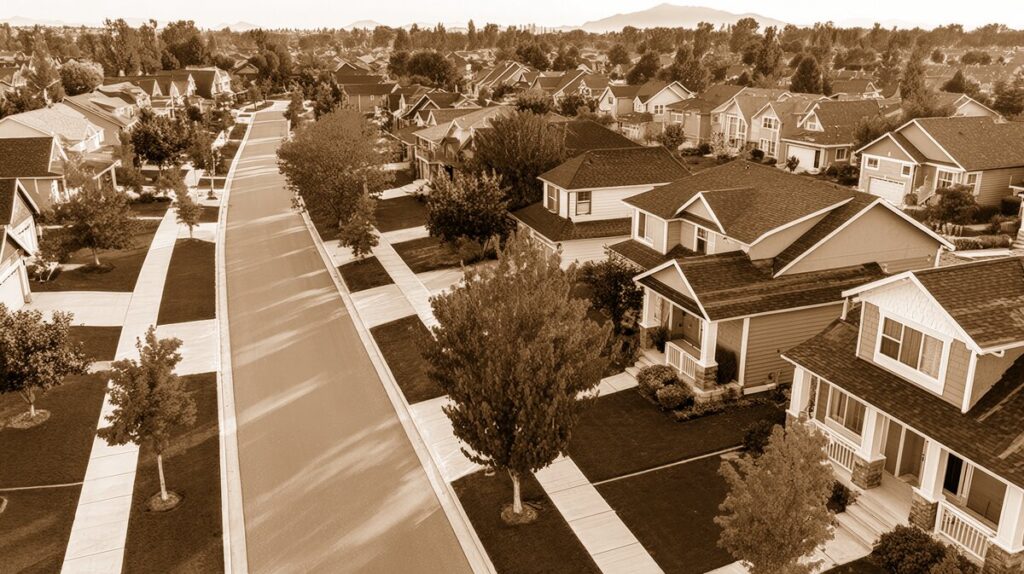
A Mountain Neighborhood with a Young History
Ashebrook Estates sits in the Candler area west of Asheville, in the broad landscape locals often describe as Enka-Candler. Unlike Montford, Biltmore Village, or Enka Village, Ashebrook Estates is not an old urban neighborhood with Victorian houses or a formally designated historic district. Its heritage is more recent—and more typical of the way western Buncombe County has grown during the past several decades.
The community represents the gradual transition from rural land and family farms to wooded residential neighborhoods. Today, homes and homesites are associated with Ashbrook Drive, Lovebird Lane, and nearby roads connecting toward Georges Branch Road and the larger Candler area. Real-estate records and local subdivision listings commonly use both “Ashebrook Estates” and “Ashebrook,” while older county planning records identify a 60-lot Ashebrook subdivision on Ashbrook Drive.
That combination of quiet roads, mature trees, mountain views, and convenient access to Asheville gives Ashebrook its particular character. It feels tucked away, but it is also part of a much older regional story.
Before the Houses: Candler’s Rural and Railroad Roots
Long before Ashebrook Estates was laid out, the surrounding land was shaped by Cherokee history, farming, timber, mills, and transportation. The region that became Buncombe County was home to Cherokee communities and travel routes for thousands of years. Asheville itself was renamed in 1793 for North Carolina Governor Samuel Ashe, a name that eventually became part of the identity of the wider region.
Candler grew into a recognizable community in the late nineteenth century. The arrival of the Western North Carolina Railroad helped create small rail centers west of Asheville, including Hominy and Candler. Rail connections gave local farmers and businesses access to markets, while stores, mills, churches, and schools gradually gathered around the transportation corridor.
That history still matters when looking at Ashebrook Estates. The neighborhood was not built in isolation. It emerged in a part of the county where roads and development followed older valleys, creeks, rail lines, and highway routes. Even the modern drive from Ashebrook toward Asheville reflects this layered geography: wooded hillsides give way to the commercial corridors of Candler and Enka, then to the larger city.
How Ashebrook Got Its Name
The exact origin of the name “Ashebrook” has not been widely documented in publicly available historical sources. There is no known published account identifying a particular Ashe family, farm, or stream as the official namesake of the subdivision.
The most reasonable interpretation is that the name combines “Ashe,” recalling Asheville and the broader Buncombe County identity, with “brook,” a familiar residential-development reference to the small waterways and wooded drainage areas common throughout the Candler hills. That explanation should be understood as an informed local reading rather than a confirmed historical fact.
The naming also fits a common pattern in modern subdivisions: developers often choose names that suggest landscape, water, trees, or regional identity. “Ashebrook Estates” sounds established and connected to Asheville while still conveying the privacy and natural setting that define the neighborhood.
A 2000s-Era Milestone
The clearest documented milestone in Ashebrook’s neighborhood history comes from the mid-2000s. Buncombe County Schools’ 2006–2007 facilities report listed Ashebrook among planned subdivisions in the Enka district, identifying the development on Ashbrook Drive and projecting approximately 60 lots. Candler Elementary was listed as the associated elementary school.
That date places Ashebrook Estates within a period of significant residential expansion in western Buncombe County. Asheville’s regional economy was attracting new residents, while former agricultural and timber properties were increasingly being divided into homesites. Many of these developments were designed for people who wanted more land and privacy than they might find in the city, but still wanted a manageable commute to Asheville.
The neighborhood’s spacious lots and wooded setting reflect that moment. Rather than a dense, sidewalk-centered subdivision, Ashebrook was planned as a semi-rural community where individual homes could sit among trees and rolling terrain. Some lots have offered winter mountain views, and listings have emphasized the neighborhood’s proximity to Interstate 40, Candler, Canton, Waynesville, and Asheville.
Nearby Landmarks and Institutions
Ashebrook Estates does not have a signature historic mansion or civic building at its center. Its landmarks are the places that connect residents to the surrounding community.
- Ashbrook Drive serves as the neighborhood’s most recognizable internal address and appears in county planning and property records.
- Lovebird Lane is associated with several larger Ashebrook Estates homesites and reflects the area’s wooded, semi-rural layout.
- Candler Elementary School has long been an important institution for families in the broader community.
- Enka-Candler Fire & Rescue represents the area’s tradition of locally organized public service. The department traces its modern roots to the transition from the company-supported Enka Fire Department to a community-based service district in the late 1980s.
- Buncombe County Sports Park, Bob Lewis Ballpark, and the developing Enka Heritage Trail provide nearby recreational connections. The trail follows Hominy Creek and is planned as a paved, multi-use route linking sports facilities and community destinations.
- Enka Village, established in 1929 as a mill village for the American Enka plant, remains one of the most important historic places near Ashebrook Estates. Its curving streets, brick homes, parks, and community buildings preserve the memory of the region’s industrial era.
Together, these places give Ashebrook residents a sense of continuity. The neighborhood may be relatively new, but it is surrounded by institutions and landscapes that have served western Buncombe County for generations.
From Mill Country to Mountain Suburb
The story of Ashebrook Estates mirrors the larger evolution of Enka-Candler. During the twentieth century, manufacturing played a central role in the local economy. American Enka and other regional industries provided jobs, built communities, and supported schools, churches, and emergency services. Later, as manufacturing declined, the area became increasingly connected to Asheville’s service, healthcare, education, tourism, and construction economies.
Ashebrook’s growth belongs to this later chapter. Its residents include longtime western North Carolina families, people relocating from other parts of the country, commuters working in Asheville, and homeowners drawn by the balance of privacy and accessibility. Over time, houses have been renovated, landscaping has matured, and once-open views have become framed by taller trees.
That gradual aging is part of the neighborhood’s charm. Ashebrook Estates is no longer simply a new subdivision, yet it has not lost the spaciousness that attracted its first residents. The community continues to evolve as homes change hands, new construction fills remaining lots, and neighbors create their own traditions.
What Makes Ashebrook Special
For a longtime local, Ashebrook Estates is special because it captures a quieter side of Asheville-area life. There are no grand boulevards or famous façades here. Instead, the character comes from the wooded roads, changing mountain light, generous lots, and the familiar rhythm of neighbors coming and going.
Its heritage is found in the land beneath the houses and in the communities around it: Cherokee homelands, railroad-era Candler, the working legacy of Enka Village, and the modern growth of western Buncombe County. Ashebrook Estates may be a young neighborhood, but it belongs to a very old landscape—and that is what gives it lasting appeal.